The Tipping Point—How Allostatic Load Drives Burnout
What if burnout isn’t just about “too much stress”—but about the body’s breaking point? Decades of research on allostatic load (McEwen, 2000) show that chronic, unrelieved stress creates cumulative wear and tear on your body and mind. For Fire/EMS, this means the job’s constant “always on” state can quietly push you past your limits—long before you realize it.
Key Findings:
Allostatic load is the total burden of chronic stress your body carries. It’s not just one bad call or a tough week—it’s the ongoing, stacked-up effect of never fully recovering between demands.
Over time, allostatic load erodes your resilience, impairs recovery, and sets the stage for burnout, depression, and even physical illness.
For first responders, shift work, sleep debt, and repeated trauma exposure accelerate this process.
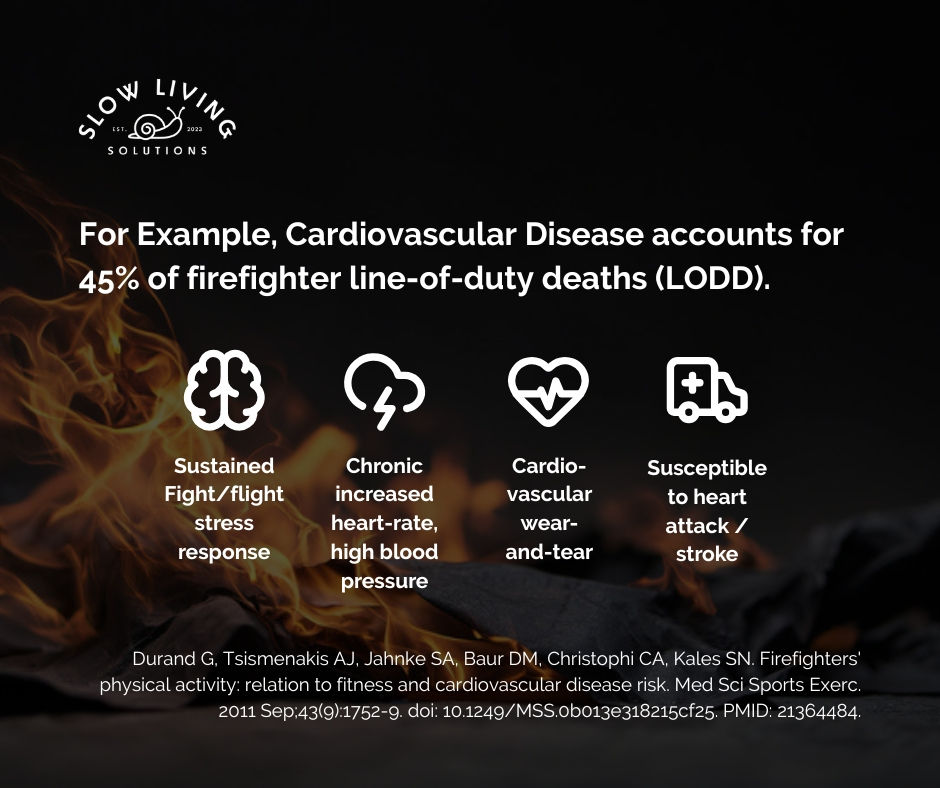
Here is one way that Allostatic Load takes a toll on firefighter health:
What’s driving the risk?
Fire/EMS culture often rewards “pushing through” and devalues rest.
Most stress management advice ignores the need to complete the body’s stress cycle—not just “manage” feelings or thoughts.
The compounding effects of stress are invisible until they show up as exhaustion, cynicism, or health problems.
One Science-Backed Solution to Allostatic Load: Complete the Stress Cycle—Don’t Just Cope
You can’t eliminate stress, but you can train your body to recover. That’s the difference between grinding and sustaining.
Try this:
After a tough call or shift, take 5–10 minutes for intentional physical decompression: walk, stretch, deep-breathe, or do a short body scan.
Notice where you feel tension or fatigue in your body—the first step is bringing awareness to how intrinsic stress feels and what your default reaction is to it. Then make a conscious decision about what decompression technique would work best for you.
Why it matters:
Completing the stress cycle reduces allostatic load and protects against long-term burnout.
Even micro-recoveries add up—think of them as “reset buttons” for your body and mind.
Sources:
Bruce S. McEwen (2006) Protective and damaging effects of stress mediators: central role of the brain, Dialogues in Clinical Neuroscience, 8:4, 367-381, DOI: 10.31887/DCNS.2006.8.4/bmcewen


Comments